
Take a course at UC Santa Cruz

This is a partial list of the courses you can take through our Open Campus program. You can finish up your degree, get your prerequisites, and expand your knowledge without being a matriculated student. Note: If you are interested in a UC Santa Cruz course that is not listed here, please contact us and we will work directly with the instructor or department to see if there is space available.

  • Online courses

  • In-person classes on campus in Santa Cruz

  • Spring courses start March 30, and the final enrollment date is April 13. See the UC Santa Cruz academic calendar.

  • Course selections are limited. Enroll today!
Applied Mathematics

Graduate-level course in dynamical systems theory, focusing on n-dimensional continuous dynamical systems. Covers fixed points, stability (linear and Lyapunov), normal forms, center manifold theorem, Liouville theorem, reversible and gradient flows, conservative systems, and quantitative characterization of chaos.

  • Days: Tuesdays and Thursdays
  • Time: 1:30 – 3:05 p.m.
  • Format: In-person
  • Location: Social Sciences 2 137
  • Instructor: Venturi,D
  • Contact for Approval: venturi@ucsc.edu
  • Units: 5

Introduces optimal control theory and computational optimal control algorithms. Topics include: calculus of variations, minimum principle, dynamic programming, HJB equation, linear-quadratic regulator, direct and indirect computational methods, and engineering application of optimal control. (Formerly AMS 232.)

  • Days: Tuesdays and Thursdays
  • Time: 11:40 a.m. - 1:15 p.m.
  • Format: In-person
  • Location: Social Sciences 2 363
  • Instructor: Kang,W.
  • Contact for Approval: wekang@ucsc.edu
  • Units: 5

Designed for STEM students and others. Through hands-on practice, this course introduces high-performance parallel computing, including the concepts of multiprocessor machines and parallel computation, and the hardware and software tools associated with them. Students become familiar with parallel concepts and the use of MPI and OpenMP together with some insight into the use of heterogeneous architectures (CPU, CUDA, OpenCL), and some case-study problems. (Formerly AMS 250.)

  • Days: Tuesdays and Thursdays
  • Time: 9:50 - 11:25a.m.
  • Format: In-person
  • Location: Crown Classroom 01
  • Instructor: Brummell,N.H.
  • Contact for Approval: brummell@ucsc.edu
  • Units: 5

Weekly seminar series covering topics of current research in applied mathematics and statistics. Permission of instructor required. Enrollment is restricted to graduate students. (Formerly AMS 280B.)

  • Days: Mondays
  • Time: 4:00- 5:05 p.m.
  • Format: In-person
  • Location: J Baskin Engineering 372
  • Instructor: Ioannidis,N.
  • Contact for Approval: nioannid@ucsc.edu
  • Units: 2

Weekly seminar/discussion group on geophysical and astrophysical fluid dynamics covering both analytical and computational approaches. Participants present research progress and findings in semiformal discussions. Students must present their own research on a regular basis. 

  • Days: TBD
  • Time: TBD
  • Format: In-person, TBD
  • Instructor: Garaud,P.
  • Contact for Approval: pgaraud@ucsc.edu
  • Units: 2

Applied Linguistics

Introduces the field of second-language acquisition. Topics include contexts of acquisition, the impact of individual differences, and basic methods of data collection and analysis.

  • Days: Tuesday and Thursdays
  • Time: 9:50 AM - 11:25 AM
  • Format: In-person
  • Location: Social Sciences 1 145
  • Instructor: Miller,D.P.
  • Contact for approval: dpmiller@ucsc.edu
  • Units: 5

Introduces the theories of second-language acquisition and their connection to second-language teaching. Students develop cutting-edge teaching and testing materials, and engage with current scholarship on language instruction. Recommend at least one year of college-level study of a foreign language, or its equivalent.

  • Days: Tuesday and Thursdays
  • Time: 11:40 a.m.- 1:15 p.m.
  • Format: In-person
  • Location: Social Sciences 1 145
  • Instructor: Miller,D.P.
  • Contact for approval: dpmiller@ucsc.edu
  • Units: 5

Helps novice instructors learn about the theory and practice of language teaching and learning. Focuses on current methods used in communicatively oriented classrooms. Topics include: listening comprehension, grammar, vocabulary, reading, writing, and testing/assessment. Students cannot receive credit for this course and course 135. (Formerly Language Studies 201.)

  • Days: Tuesday and Thursdays
  • Time: 11:40 a.m. - 1:15 p.m.
  • Format: In-person
  • Location: Social Sciences 1 145
  • Instructor: Miller,D.P.
  • Contact for approval: dpmiller@ucsc.edu
  • Units: 5

Art

Introduces students to the fundamental principles of four-dimensional art and design. This is a large lecture-based course with smaller art studio-based sections (60% lecture/40% studio). Lecture, discussion, and studio sections explore fundamental principles of 4D/time-based art and design concepts, techniques, and technical practices. Computers and video, photo, sound, and lighting equipment are used to create short-form, time-based work. Through lectures, discussion, and studio projects students learn complex concepts in 4D.

  • Days: Tuesdays and Thursdays
  • Time: 5:20 - 6:55 p.m.
  • Format: In-person
  • Location: Oakes Academy 105
  • Instructor: Dolgov,I.
  • Contact for Approval: idolgov@ucsc.edu
  • Units: 5

Combines an introduction to computer programming for beginners with special topics that are essential for the digital arts. Basic concepts of programming are developed in the JavaScript language and applied to digital arts media, such as algorithmically generated still images and animations in two and three dimensions, sound art, and music composition. Presentation of digital artwork in the theater and via the web are covered in detail.

  • Days: Tuesdays and Thursdays
  • Time: 11:40 a.m. - 1:15 p.m.
  • Format: In-person
  • Location: Kresge Academy 3201
  • Instructor: Dolgov,I.
  • Contact for Approval: idolgov@ucsc.edu
  • Units: 5

Biology Ecology and Evolutionary

An intensive, on-site learning experience in terrestrial field ecology and conservation, using the University of California Natural Reserves and other natural areas. Students study advance concepts in ecology, conservation, and field methods for four weeks, then experience total immersion in field research at the UC Natural Reserves and other natural areas. Lectures, field experiments, writing assignments, and computer exercises familiarize students with research methods, study design, statistical approaches, and analytical tools for ecological research. Students complete and communicate the results of short field projects in ecology, learn the natural history of the flora and fauna of California, and plan and execute a significant, independent field-research study at the end of the quarter. 

Field-oriented course in ecological research. Combines overview of methodologies and approaches to field research with practical field studies. Students complete field projects in ecology and also learn the natural history of the flora and fauna of California. Students are billed a materials fee of $1,450. Enrollment is by application.

From lectures and discussion of terrestrial community and ecosystem ecology, students work individually or in small groups to present an idea for a project, review relevant literature, develop a research question/hypothesis, design and perform an experiment, collect and analyze data, and write a report. The instructor evaluates the feasibility of each student's project before it begins. Enrollment is by application.

Focuses on current issues in environmental and conservation biology and the emerging field methods used to address them. From field-oriented lectures about current issues in environmental and conservation biology, students pursue research project as individuals and small groups to develop hands-on experience with field skills in conservation research and resource management. Enrollment is by application.

Designed for the discussion and evaluation of current topics in genetics. Integrates information from multiple fields and focuses on how genetics continues to shape numerous areas, including new emerging areas. Focuses on topics of current interest in genetics and includes lectures, readings, and discussions. Students present on a current genetics’ topic of interest in the last week of the class. This is a course that requires extensive readings, participation in discussions, written assignments, and oral presentations. This course also provides an opportunity for you to practice critical thinking, quantitative analysis, and cooperative learning. Throughout the semester, students will discuss the latest genetic technologies and their impact on society including ethical, economic, and environmental concerns.

  • Days: Tuesdays, Thursdays
  • Time: 12:25 - 2:00 p.m.
  • Format: In-person
  • Location: Coastal Biology Building 110
  • Instructor: Kelley,J.L.
  • Contact for approval: jokelley@ucsc.edu
  • Units: 5

Chinese

Continuation of Chinese 2, which assumes that students are familiar both with the pinyin romanization system and approximately 300 basic characters.

  • Days: MWF
  • Time: 12:00 - 1:05 p.m.
  • Format: In-person,
  • Location: Stevensom Academy 151
  • Instructor: Chan,A.
  • Contact for approval: achan146@ucsc.edu
  • Units: 5

Continuation of Chinese 5. Conversation, composition, and the reading of modern texts.

          Section 01:

  • Days: MWF
  • Time: 8:00 - 9:05 a.m.
  • Format: In-person
  • Location: Social Sciences 2 165
  • Instructor: Wu,T.
  • Contact for approval: tingting@ucsc.edu
  • Units: 5

    Section 02:

  • Days: MWF
  • Time: 9:20 -10:25 a.m.
  • Format: In-person
  • Location: Social Sciences 2 165
  • Instructor: Wu,T.
  • Contact for approval: tingting@ucsc.edu
  • Units: 5

Offers an appreciation of some of the central issues in Chinese history as defined by Chinese historians of the 20th century. Through readings of graduated difficulty, the vocabulary, style, and form of modern Chinese historical writing are introduced.

  • Days: MWF
  • Time: 10:40 -11:45 a.m.
  • Format: In-person
  • Location: Social Sciences 2 165
  • Instructor: Wu,T.
  • Contact for approval: tingting@ucsc.edu
  • Units: 5

Computational Media

Examines games as technical and cultural artifacts—shaped by society and, in turn, shaping it. Core topics are traced over time, including social, technical, and artistic topics (for example: conceptions of war, platform affordances, and genre evolution).

  • Days: MWF
  • Time: 1:20 - 2:25 p.m.
  • Format: In-person
  • Location: Kresge Acad 3201
  • Instructor: Staff
  • Contact for approval: TBD
  • Units: 5

Teaches the concrete programming and collaboration skills associated with making a digital game from start to finish, including but not limited to: establishing a team, concepting, storyboarding, prototyping, producing, and testing a game for release. Students are organized into groups and work together to create and produce a playable game.

Section 01:

  • Days: MWF
  • Time: 2:40 - 3:45 p.m.
  • Format: In-person
  • Location: Thimann Lecture 001
  • Instructor: Smith,A.M.
  • Contact for approval: amsmith@ucsc.edu
  • Units: 5

Section 02:

  • Days: MWF
  • Time: 4:00 - 5:05 p.m.
  • Format: In-person
  • Location: Thimann Lecture 001
  • Instructor: Whitehead,J.
  • Contact for approval: ejw@ucsc.edu
  • Units: 5

Cowell College

Overview of the financial responsibilities that young adults take on after college. Topics include: taxes, budgeting, student loans, credit, and investing in the stock market. Ubiquitous terms, such as 401(k), are defined, and financial principles are used to develop a framework for personal financial decision-making.

  • Days: TBA
  • Time: TBA
  • Format: Online
  • Instructor: Kelly,P.M.
  • Contact for approval: pmkelly@ucsc.edu
  • Units: 5

Overview of the financial responsibilities that young adults take on after college. Topics include: taxes, budgeting, student loans, credit, and investing in the stock market. Ubiquitous terms, such as 401(k), are defined, and financial principles are used to develop a framework for personal financial decision-making.

  • Days: TBA
  • Time: TBA
  • Format: Online
  • Instructor: Kelly,P.M.
  • Contact for approval: pmkelly@ucsc.edu
  • Units: 5

Do you ever think, "I want to make a difference!" but don't know where to start? In this class, students learn design thinking theory and methods and apply them to their lives, specifically to the question of what to do after college. Students build deeper awareness of their values and goals, define areas of life and work they want to grow in, ideate multiple life paths, prototype elements of careers of interest, and take small steps to try these out. This is an experiential class that asks students to try new ways of thinking and step outside comfort zones as they learn a creative problem-solving approach applicable in many contexts. (Formerly offered as CLNI 140.)

  • Days: Tuesdays
  • Time: 9:50 -11:25 a.m.
  • Format: In-person
  • Location: Stevenson Academy 175
  • Instructor: Stinneford,C.M.
  • Contact for approval: cstinnef@ucsc.edu
  • Units: 5

Crown College

Marketing for Good is a service-learning course. Student teams are matched with real-world clients, establish their needs through interviews, and develop a marketing plan. This plan may include branding, logo design, messaging, digital storytelling (through video, film or photography), website and social media campaigns, and more. During its execution, students take on roles and responsibilities that mirror the industry such the rols of writer, art director, product marketing head, and marketing strategist. Thus, students experience the totality of a marketing project, getting a firsthand understanding of how marketing teams work and how they can scale as the size of the team grows. May be repeated for credit.
 

  • Days: Tuesday, and Thursdays
  • Time: 5:20 - 6:55 p.m.
  • Format: Hybrid
  • Instructor: Monastyrska,Y.
  • Contact for approval: ymonasty@ucsc.edu
  • Units: 5

Community service-oriented class that provides a supervised learning experience for students to help increase local business client acquisition, integrating academic coursework with community involvement. Students gain valuable practical skills as consultants. They are trained to do interviews, write proposals, project-manage, design websites, and marketing campaigns. No prerequisites are required but CRWN 90 or CRWN 92 are highly recommended to acquire familiarity with the lean startup method, the business model canvas, and customer discovery. May be repeated for credit. (Formerly CRWN 95, GetVirtual Business Assistance.) May be repeated for credit.

  • Days: Tuesday, and Thursdays
  • Time: 9:50 - 11:25 a.m.
  • Format: Online
  • Instructor: Monastyrska,Y.
  • Contact for approval: ymonasty@ucsc.edu
  • Units: 5

Computer Science Engineering

Introduction to computer architecture including examples of current approaches and the effect of technology and software. Computer performance evaluation, basic combinatorial and sequential digital components, different instruction set architectures with a focus on the MIPS ISA and RISC paradigm. Evolution of CPU microarchitecture from single-cycle to multi-cycle pipelines, with overview of super-scalar, multiple-issue and VLIW. Memory system, cache, virtual memory and relationship between memory and performance. Evolution of PC system architecture. May include advanced topics, such as parallel processing, MIMD, and SIMD.

Section 01:

  • Days: Tuesday and Thursdays
  • Time: 5:20 - 6:55 p.m.
  • Format: In-person
  • Location: Oakes Academy 105
  • Instructor: Nath,S.
  • Contact for approval: sanath@ucsc.edu
  • Units: 5

Section 02

  • Days: MWF
  • Time: 4:00 - 5:05 p.m.
  • Format: In-person
  • Location: Oakes Academy 105
  • Instructor: Souza,A.
  • Contact for approval: absouza@ucsc.edu
  • Units: 5

Film and Digital Media

An introduction to the basic elements, range, and diversity of cinematic representation and expression. Aesthetic, theoretical, and critical issues are explored in the context of class screenings and critical readings. If space allows, restrictions may be lifted after priority enrollment.

  • Days: Monday and Wednesday
  • Time: 9:50 - 11:45 a.m.
  • Format: In-person
  • Location: Communications Building 150
  • Instructor: Horne,J.
  • Contact for approval: jenny@ucsc.edu
  • Units: 5

Introduction to the production processes of visual/aural, time-based, creative work. Students work on a range of creative projects: performed, written, photographed, and created digitally. Assignments emphasize imaginative problem-solving, collaboration, visualization, and critical media literacy. 

  • Days: Tuesday and Thursday
  • Time: 11:40 a.m. - 1:15 p.m.
  • Format: In-person
  • Location: Kresge Academy 3105
  • Instructor: Lareau,Q.A.
  • Contact for approval: qlareau@ucsc.edu
  • Units: 5

Long extinct species coming back to life from melting ice caps, humanity seeking refuge in manmade ecologies, and extreme weather events ravaging global landscapes. These all belong to the ecological imaginary of 21st century cinema/media. With the aid of new technologies and CGI, films increasingly stretch the boundaries of cinematic time and space across deep pasts, vast futures, and previously unmappable territories in order to project visions of humanity under constant threat by factors of its own making. This course explores what we can learn about human-nature relations and environmental concerns from moving images, differently from other disciplines. While the focus is mostly on eco-cinema, course also looks at broader eco-media and our ways of knowing the world.

  • Days: Monday and Wednesday
  • Time: 5:20 - 6:55 p.m.
  • Format: In-person
  • Location: Media Theater M110
  • Instructor: Kara,S.
  • Contact for approval: sekara@ucsc.edu
  • Units: 5

This course explores the history of Santa Cruz County through the lens of cinema, examining how film both reflects and reshapes our understanding of place. Students will study feature films and documentaries shot in Santa Cruz and Monterey County alongside local history, focusing on the communities, conflicts, and cultures that have shaped the region. We will screen films such as Vertigo, Us, The Lost Boys, and Killer Klowns from Outer Space in dialogue with documentaries, archival materials, and historical readings.

  • Days: Tuesday and Thursday
  • Time: 5:20 - 6:55 p.m.
  • Format: In-person
  • Location: Media Theater M110
  • Instructor: Rizzo-Martinez,M.
  • Contact for approval: mrizzo@ucsc.edu
  • Units: 5

History of Art and Visual Culture

Survey of the visual and material products of European contact with Africa, Asia, Oceania, and the Americas between 1500 and 1900 focused both on object-specific case studies and thematic discussions of contact, colonialism, appropriation, and the visual construction of race.

  • Days: MWF
  • Time: 10:40 - 11:45 a.m.
  • Format: In-person
  • Location: Oakes Academy 105
  • Instructor: Polzak,K.
  • Contact for approval: kpolzak@ucsc.edu
  • Units: 5

Explores the history of collecting and displaying art (museums, galleries, fairs) since the mid-19th century and the effect of institutional changes on aesthetic conventions. Follows the history from the origins of museums and collections to contemporary critiques of institutional exclusion and misrepresentation.

  • Days: MWF
  • Time: 9:20 - 10:25 a.m.
  • Format: In-person
  • Location: Oakes Academy 105
  • Instructor: Gonzalez,J.A.
  • Contact for approval: jag@ucsc.edu
  • Units: 5

Examines how photography was used in Southeast Asia to document the racial difference and the exotic Others under the regime of colonialism. Considers the role photography played in documenting the Vietnam-American War and how contemporary Southeast Asian-American artists challenge this photographic history in their art.

  • Days: Tuesdays and Thursdays
  • Time: 1:30 - 3:05 p.m.
  • Format: In-person
  • Location: Rachel Carson Academy 240
  • Instructor: Ly,B.J.
  • Contact for approval: bjly@ucsc.edu
  • Units: 5

Examines key moments and projects in site-specific art since the 1960s, including Earth Works, the rise of installation art, and the interplay between artists and institutional venues sponsoring such projects, including museums, private galleries and patrons, and biennials.

  • Days: Tuesdays and Thursdays
  • Time: 1:30 - 3:05 p.m.
  • Format: In-person
  • Location: Social Sciences 1 110
  • Instructor: Wasserman,M.
  • Contact for approval: mowasser@ucsc.edu
  • Units: 5

Electrical and Computer Engineering

Introduces to a lay audience engineering innovations that have had an impact in medicine and biology. Course is designed for non-engineering majors, or pre-med students, as well as pre-engineering to provide a broad understanding of how technology has improved and keeps on improving healthcare.

  • Days: TTh
  • Time: 1:30 - 3:05 p.m.
  • Format: In-person
  • Location: Physical Sciences 114
  • Instructor: Abbaszadeh,S.
  • Contact for approval: sabbasza@ucsc.edu
  • Units: 5

Course will cover electromagnetic wave propagation, transmission lines, waveguides, and antennas. 
 
  • Days: TTh
  • Time: 1:30 - 3:05 p.m.
  • Format: In-person
  • Location: Engineer 2 194
  • Instructor: Corzine,K.
  • Contact for approval: corzine@ucsc.edu
  • Units: 5

Engineering design cycle for wireless and RF systems: design, practical hardware implementation, and prototype. 

  • Days: MWF
  • Time: 2:40 - 3:45 p,m,
  • Format: In-person
  • Location: Jack Baskin Engineering 156
  • Instructor: Petersen,S.C.
  • Contact for approval: ac6p@ucsc.edu
  • Units: 5
 

Laboratory to accompany course 157, emphasizing hardware-design practice and principles applies to RF apparatus. Students design and implement a substantial final project during the last half of the course.

  • Days: TBD
  • Time: TBD
  • Format: In-person
  • Location: TBD
  • Instructor: Petersen,S.C.
  • Contact for approval: ac6p@ucsc.edu
  • Units: 5

Guides students through the process of securing financing for their new high-growth technology company. Discusses the various types and sources of financing, the financing and due diligence processes, the expectations of institutional investors and the underlying drivers for those expectations. Students also analyze the implications of the various terms and conditions of a financing term sheet to understand the typical negotiation options available when negotiating terms with investors. Course also reviews the required set of legal documents required to close a financing round. ECE 186, Entrepreneurship I, is highly recommended but not required.

  • Days: Tuesdays and Thursdays
  • Time: 9:50 - 11:25 a.m.
  • Format: In-person
  • Location: Jack Baskin Engineering 165
  • Instructor: Vroomen,P.H.
  • Contact for approval: pvroomen@ucsc.edu
  • Units: 5

Covers narrowband and high-frequency techniques, noise, distortion, nonlinearities, low-noise amplifiers, power amplifiers, mixers, receivers, and transmitters for wireless communications. Topics are presented in the context of integrated designs in CMOS, but topics are fundamental and widely applicable.

  • Days: Tuesdays and Thursdays
  • Time: 3:20 - 4:55 p.m.
  • Format: In-person
  • Location: Social Sciences 1 149
  • Instructor: Pedrotti,K.
  • Contact for approval: pedrotti@ucsc.edu
  • Units: 5

A core course on digital communications theory. Provides an introduction to digital communication, including source coding, characterization of communication signals and systems, modulation and demodulation for the additive Gaussian channel, digital signaling, and over bandwidth constrained linear filter channels and over fading multipath channels. 

  • Days: Tuesdays and Thursdays
  • Time: 9:50 - 11:25 a.m.
  • Format: In-person
  • Location: Social Sciences 2 171
  • Instructor: Moltafet,M.
  • Contact for approval: mmoltafe@ucsc.edu
  • Units: 5

Education

Survey course exploring the foundational perspectives on learning, especially when considering learners from non-dominant communities, how those views of learning are reflected in what and how students learn in school and out of school, and how those views of learning can impact teaching practices.

  • Days: Mondays and Wednesdays
  • Time: 7:10 - 8:45 p.m.
  • Format: In-person
  • Location: Jack Baskin Engineering 152
  • Instructor: Caldwell,B.M.
  • Contact for approval: bbettner@ucsc.edu
  • Units: 5

History

Introduces the History of Islam, its spread over Africa, and the role of the African diaspora in making Islam a global religion. Course delves into the role of African and African diasporic communities in globalizing Islam and considers the relationship between Islam and local cultures to understand how religious unity and cultural diversity within Islam interact. It also aims to develop tools to interpret how race and ethnicity have been used by and applied to African Muslims within the global Muslim community.

  • Days: Tuesdays and Thursdays
  • Time: 1:30 - 3:05 p.m.
  • Format: In-person
  • Location: Porter Academy 148
  • Instructor: Mota,T.
  • Contact for approval: tmota@ucsc.edu
  • Units: 5

Examines a series of distinguished documentary and feature films about the destruction of European Jewry. Each film is placed in its historical context, and wherever possible, the readings include the original documents on which films were based. Emphasis is placed on the strategies the filmmakers used to address the problem of representing genocide without succumbing to mere melodrama. 

  • Days: Tuesdays and Thursdays
  • Time: 7:10 - 8:45 p.m.
  • Format: In-person
  • Location: Stevenson Academy 150
  • Instructor: Thompson,B.A.
  • Contact for approval: brucet@ucsc.edu
  • Units: 5

The civil rights movement of the 1950s and 1960s, also referred to as the Second Reconstruction, was one of the most consequential periods in United States history. This course examines the many facets of the movement, focusing on the strategies, grassroots campaigns, and the many rank-and-file women and men who fought for freedom, liberation, and justice.

  • Days: Mondays and Wednesdays
  • Time: 5:20 - 6:55 p.m.
  • Format: In-person
  • Location: Natural Sciences Annex 101
  • Instructor: Cobbins-Modica,Q.
  • Contact for approval: qcobbins@ucsc.edu
  • Units: 5

Surveys the history of African Americans from the post-Reconstruction and Jim Crow era to the present. Topics include northern and westward migration, women’s suffrage and activism, the world wars, black nationalism, the Harlem Renaissance, the Great Depression, the Civil Rights and Black Power Movements, and black activism in contemporary America.

  • Days: Tuesdays and Thursdays
  • Time: 8:00 - 9:35 a.m.
  • Format: In-person
  • Location: Social Sciences 2 071
  • Instructor: Cobbins-Modica,Q.
  • Contact for approval: qcobbins@ucsc.edu
  • Units: 5

Covers the social, cultural, economic, and political history of colonial Mexico (New Spain). Special attention paid to colonial identity formation, religion, and labor systems. Begins by examining indigenous societies prior to the arrival of Europeans and concludes with Mexico's independence movement in the early 19th century.

  • Days: Tuesdays and Thursdays
  • Time: 5:20 - 6:55 p.m.
  • Format: In-person
  • Location: Porter Academy 148
  • Instructor: TBD
  • Contact for approval: TBD
  • Units: 5

Literature

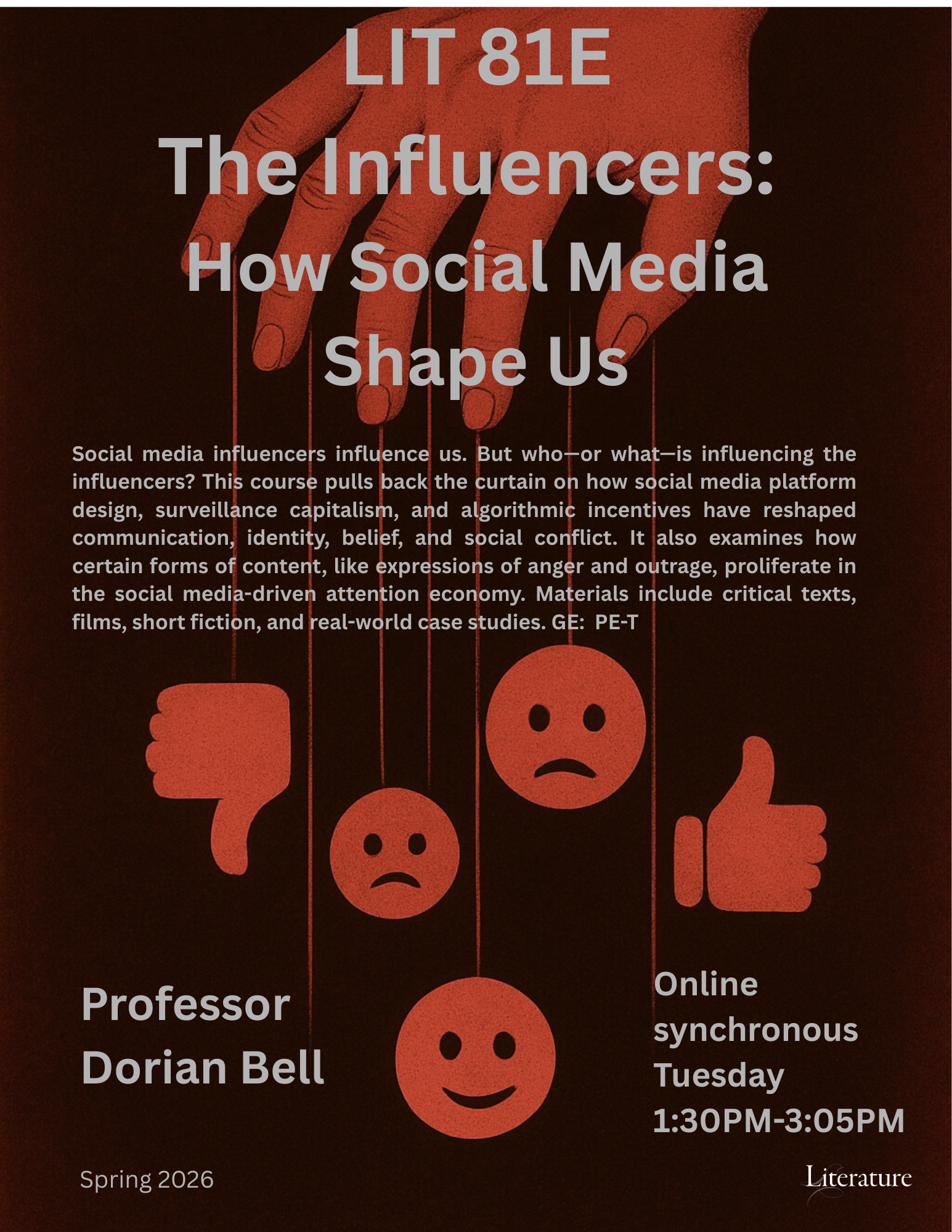
Social media influencers influence us. But who—or what—is influencing the influencers? This course pulls back the curtain on how social media platform design, surveillance capitalism, and algorithmic incentives have reshaped communication, identity, belief, and social conflict. It also examines how certain forms of content, like expressions of anger and outrage, proliferate in the social media-driven attention economy. Materials include critical texts, films, short fiction, and real-world case studies.

  • Days: Tuesdays and Thursdays
  • Time: 1:30 - 3:05 p.m.
  • Format: In-person
  • Location: McHenry Library 1340
  • Instructor: Bell,D.
  • Contact for approval: dbell1@ucsc.edu
  • Units: 5

Flyer

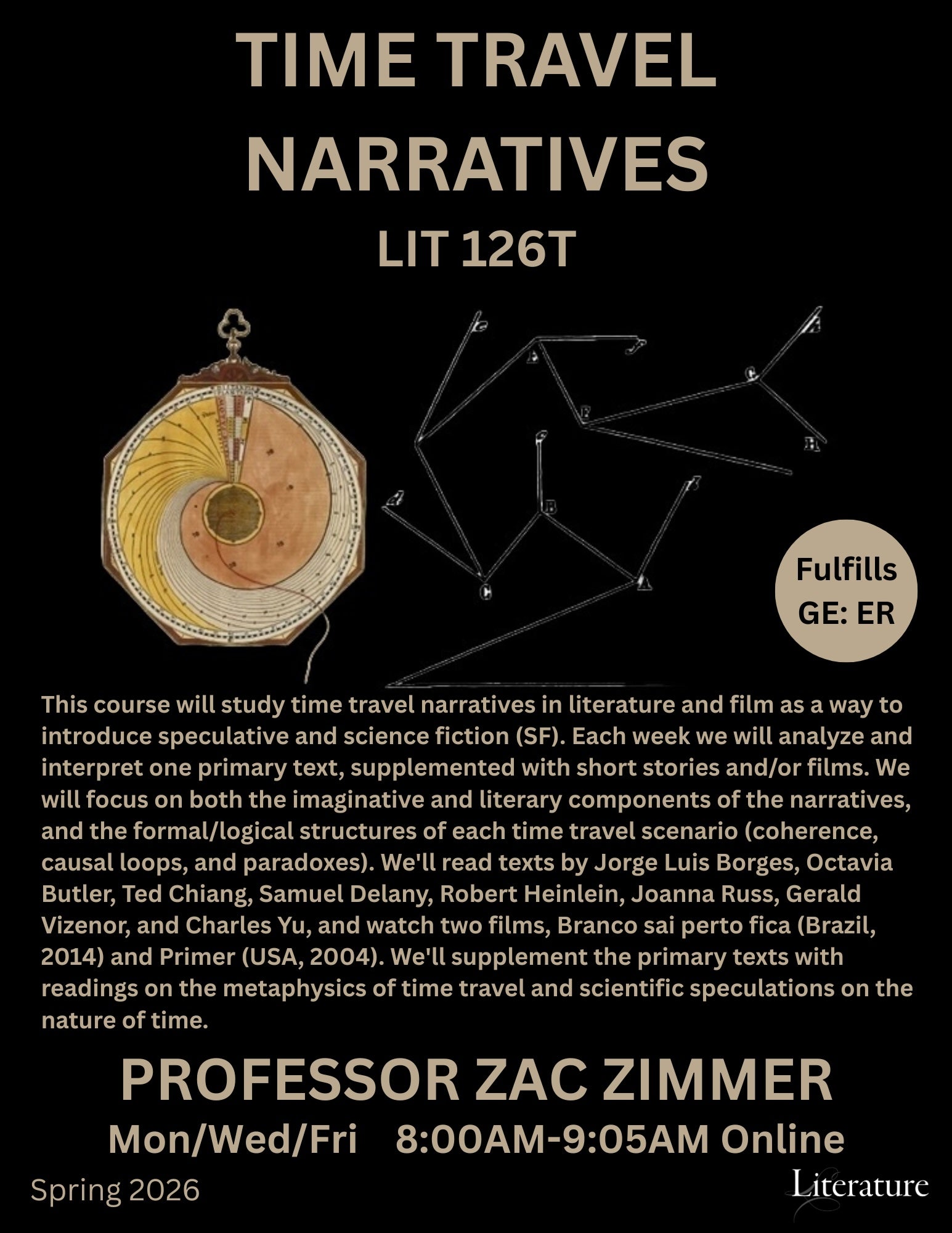
Explores time travel narratives in literature and film as an introduction to speculative and science fiction. Each week, a primary text is analyzed, supplemented with short stories and/or films. Focus is on both the imaginative/literary elements and the formal/logical structures of each time travel scenario. Authors may include Butler, Chiang, Delany, Heinlein, Russ, Vizenor, and Yu.

  • Days: MWF
  • Time: 8:00 - 9:05 a.m.
  • Format: Synchronous Online
  • Location: Zoom
  • Instructor: Zimmer,Z.A.
  • Contact for approval: zaazimme@ucsc.edu
  • Units: 5

Flyer

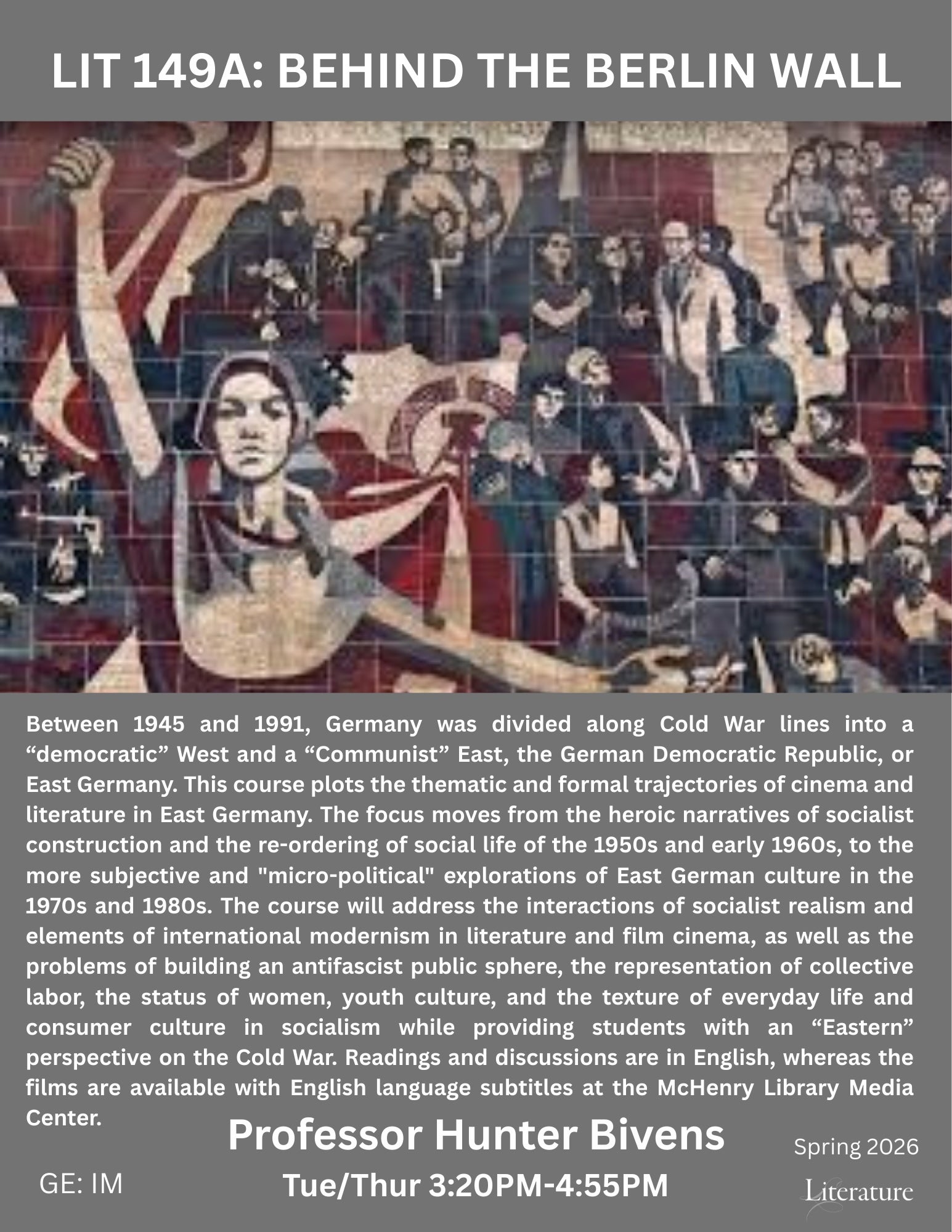
Examines cultural life in the German Democratic Republic between 1946 and 1992 through films from the state-owned DEFA film studios. Topics include: socialist realism and international modernism in cinema; the representation of collective labor; the status of women; youth culture; and the texture of everyday life and consumer culture in socialism.

  • Days: Tuesdays and Thursdays
  • Time: 3:20 - 4:55 p.m.
  • Format: In-person
  • Location: Stevenson Academy 152
  • Instructor: Bivens,A.H.
  • Contact for approval: abivens@ucsc.edu
  • Units: 5

Flyer


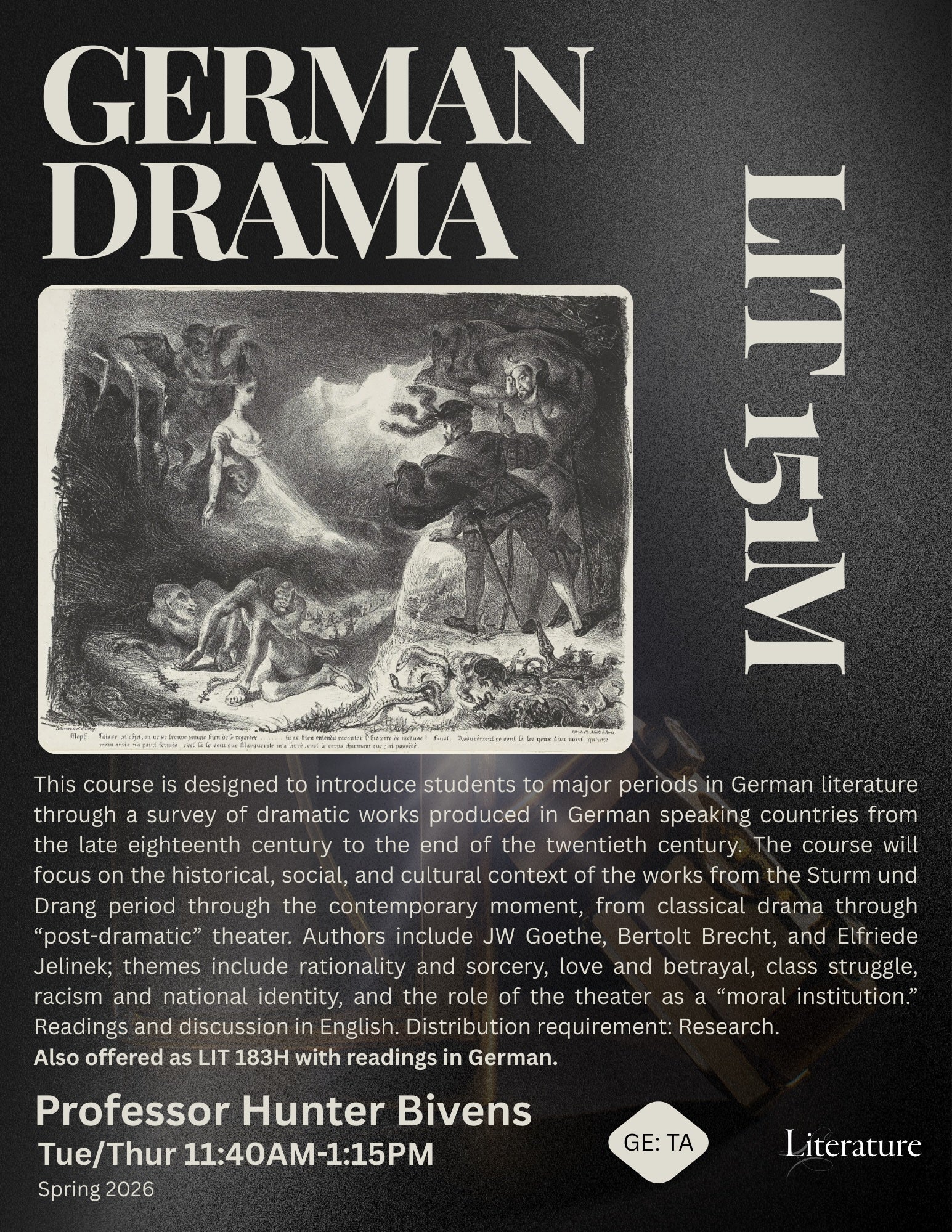
Introduces students to major periods in German literature through a survey of dramatic works produced in German speaking countries from the late 18th century to the end of the 20th century. The course focuses on the historical, social, and cultural context of the works from the Sturm und Drang period through the contemporary moment. Authors include JW Goethe, Friedrich Schiller, Gerhart Hauptmann, and Elfriede Jelinek. Readings and discussion will be in English

  • Days: Tuesdays and Thursdays
  • Time: 11:40 a.m. - 1:15 p.m.
  • Format: In-person
  • Location: Social Sciences 1 161
  • Instructor: Bivens,A.H.
  • Contact for approval: abivens@ucsc.edu
  • Units: 5

Flyer

Our world is saturated with information and much of it is inaccurate. This class teaches how to to identify bad information and how to keep it from spreading. It explores the role and responsibility of journalism in the world and why it matters. It investigates where information originates and the motivations of those producing, spreading, and sharing it, and pushes students to consider their media diet and how it affects their life and understanding of the world.

  • Days: Tuesdays and Thursdays
  • Time: 9:50 - 11:25 a.m.
  • Format: In-person
  • Location: Science & Engineering Library 206
  • Instructor: Kleinberg Biehl,J.
  • Contact for approval: jkbiehl@ucsc.edu
  • Units: 5

Flyer

An examination of some major Jewish writers and their responses to the American city. Major writers: Henry Roth, Saul Bellow, Bernard Malamud, J. Kaplan, Philip Roth. A look at Yiddish and other minority writers, and including sociological and historical materials on the American city. The course topic changes; please see the Class Search for the current topic. Critical approach designations: Histories, Power and Subjectivities.

  • Days: MWF
  • Time: 12:00 - 1:05 p.m.
  • Format: In-person
  • Location: Physical Sciences 140
  • Instructor: Thompson,B.A.
  • Contact for approval: brucet@ucsc.edu
  • Units: 5

Flyer

Mathematics

The limit of a function, calculating limits, continuity, tangents, velocities, and other instantaneous rates of change. Derivatives, the chain rule, implicit differentiation, higher derivatives. Exponential functions, inverse functions, and their derivatives. The mean value theorem, monotonic functions, concavity, and points of inflection. Applied maximum and minimum problems.

Section 01:

  • Days: MWF
  • Time: 9:50 - 11:25 a.m.
  • Format: In-person
  • Location: Stevenson Academy 150
  • Instructor: Tamanoi,H.
  • Contact for approval: tamanoi@ucsc.edu
  • Units: 5

Section 02:

  • Time: Asynchronous Online
  • Format: Asynchronous Online
  • Instructor: Barron,P.
  • Contact for approval: phbarron@ucsc.edu
  • Units: 5

The definite integral and the fundamental theorem of calculus. Areas, volumes. Integration by parts, trigonometric substitution, and partial fractions methods. Improper integrals. Sequences, series, absolute convergence and convergence tests. Power series, Taylor and Maclaurin series

Section 01:

  • Days: MWF
  • Time: 10:40 - 11:45 a.m.
  • Format: In-person
  • Location: Kresge Academy 3201
  • Instructor: Monteiro,N.
  • Contact for approval: namontei@ucsc.edu
  • Units: 5

Section 02:

  • Time: Asynchronous Online
  • Format: Asynchronous Online
  • Instructor: Barron,P.
  • Contact for approval: phbarron@ucsc.edu
  • Units: 5

Systems of linear equations matrices, determinants. Introduces abstract vector spaces, linear transformation, inner products, the geometry of Euclidean space, and eigenvalues. 

  • Days: MWF
  • Time: 12:00 - 1:05 p.m.
  • Format: In-person
  • Location: Humanities Lecture Hall
  • Instructor: Escobar Vega,L.
  • Contact for approval: lescoba6@ucsc.edu
  • Units: 5

Vectors in n-dimensional Euclidean space. The inner and cross products. The derivative of functions from n-dimensional to m-dimensional Euclidean space is studied as a linear transformation having matrix representation. Paths in 3-dimensions, arc length, vector differential calculus, Taylor's theorem in several variables, extrema of real-valued functions, constrained extrema and Lagrange multipliers, the implicit function theorem, some applications.

Section 01:

  • Time: Asynchronous Online
  • Format: Asynchronous Online
  • Instructor: Barron,P.
  • Contact for approval: phbarron@ucsc.edu
  • Units: 5

Section 02:

  • Days: MWF
  • Time: 10:40 - 11:45 a.m.
  • Format: In-person
  • Location: Earth&Marine B206
  • Instructor: Barron,P.
  • Contact for approval: phbarron@ucsc.edu
  • Units: 5

Double integral, changing the order of integration. Triple integrals, maps of the plane, change of variables theorem, improper double integrals. Path integrals, line integrals, parametrized surfaces, area of a surface, surface integrals. Green's theorem, Stokes' theorem, conservative fields, Gauss' theorem.

  • Time: Asynchronous Online
  • Format: Asynchronous Online
  • Instructor: Barron,P.
  • Contact for approval: phbarron@ucsc.edu
  • Units: 5

Complex numbers, analytic and harmonic functions, complex integration, the Cauchy integral formula, Laurent series, singularities and residues, conformal mappings. 

  • Days: MWF
  • Time: 1:20 - 2:25 p.m.
  • Format: In-person
  • Location: Natural Sciences Annex 101
  • Instructor: Serboi,S.
  • Contact for approval: sserboi@ucsc.edu
  • Units: 5

Topics covered include first and second order linear partial differential equations, the heat equation, the wave equation, Laplace's equation, separation of variables, eigenvalue problems, Green's functions, Fourier series, special functions including Bessel and Legendre functions, distributions and transforms.

  • Days: Tuesdays and Thursdays
  • Time: 11:40 a.m. - 1:15 p.m.
  • Format: In-person
  • Location: Earth & Marine Building 214
  • Instructor: Qing,J.
  • Contact for approval: qing@ucsc.edu
  • Units: 5

Introduction to rings and fields including polynomial rings, factorization, the classical geometric constructions, and Galois theory. 

  • Days: Tuesdays and Thursdays
  • Time: 11:40 a.m. - 1:15 p.m.
  • Format: In-person
  • Location: McHenry Library Classroom 1279
  • Instructor: Boltje,R.
  • Contact for approval: boltje@ucsc.edu
  • Units: 5

Based on induction and elementary counting techniques: counting subsets, partitions, and permutations; recurrence relations and generating functions; the principle of inclusion and exclusion; Polya enumeration; Ramsey theory or enumerative geometry.

  • Days: MWF
  • Time: 4:00 - 5:05 p.m.
  • Format: In-person
  • Location: Physical Sciences 130
  • Instructor: Mackall,E.
  • Contact for approval: emackall@ucsc.edu
  • Units: 5

Euclidean, projective, spherical, and hyperbolic (non-Euclidean) geometries. Begins with the thirteen books of Euclid. Surveys the other geometries. Attention paid to constructions and visual intuition as well as logical foundations. Rigid motions and projective transformations covered.

  • Days: Tuesdays and Thursdays
  • Time: 3:20 - 4:55 p.m.
  • Format: In-person
  • Location: Cowell Classroom 131
  • Instructor: Navarro,D.
  • Contact for approval: dnavar17@ucsc.edu
  • Units: 5

The Lorenz and Rossler attractors, measures of chaos, attractor reconstruction, and applications from the sciences.

  • Days: MWF
  • Time: 2:40 - 3:45 p.m.
  • Format: In-person
  • Location: Social Sciences 2 179
  • Instructor: Quan,H.
  • Contact for approval: hquan1@ucsc.edu
  • Units: 5

Laboratory sequence illustrating topics covered in MATH 145. One three-hour session per week in microcomputer laboratory.

Section 01: 

  • Days: Tuesdays
  • Time: 3:20 - 4:25 p.m.
  • Format: In-person
  • Location: McHenry Classroom 1267
  • Instructor: Quan,H.
  • Contact for approval: hquan1@ucsc.edu
  • Units: 5

Section 02:

  • Days: Thursdays
  • Time: 3:20 - 4:25 p.m.
  • Format: In-person
  • Location: McHenry Classroom 1267
  • Instructor: Quan,H.
  • Contact for approval: hquan1@ucsc.edu
  • Units: 5

Ocean Sciences

Interdisciplinary scientific perspective on Earth system, focusing on human impacts on global environment. Introduces concepts of Earth system science and explores topics such as global warming, ozone depletion, pollution, deforestation, and future climate change.

  • Days: MWF
  • Time: 12:00 - 1:05 p.m.
  • Format: In-person
  • Location: Thimann Lecture 001
  • Instructor: Polissar,P.
  • Contact for approval: ppolissa@ucsc.edu
  • Units: 5

Quantitative introduction to climate comprising five modules: atmosphere-ocean circulation, atmospheric teleconnections, El-Nino Southern Oscillation, the Pacific Decadal Oscillation, and global warming. Hands-on statistical methods are applied to real-world observations to develop a quantitative understanding of climate. 

  • Days: MWF
  • Time: 10:40 - 11:45 a.m.
  • Format: In-person
  • Location: Thimann Lecture 001
  • Instructor: Beaulieu,C.
  • Contact for approval: clbeauli@ucsc.edu
  • Units: 5

Physical Education

Coeducational. Course includes a review of basic sailing with an emphasis on the further development and refinement of small-boat sailing techniques. Fifteen-foot sailboats are used with two students per boat.

  • Days: Wednesdays
  • Time: 12:30 - 3:00 p.m.
  • Format: In-person
  • Location: Harbor
  • Instructor: Teel,C.L.
  • Contact for approval: clteel@ucsc.edu
  • Units: 5

Coeducational intermediate course designed to cover more advanced rowing techniques and the skills needed for safe open water rowing.

Section 01:

  • Days: Tuesdays and Thursdays
  • Time: 8:00 - 9:45 a.m.
  • Format: In-person
  • Location: Harbor
  • Instructor: Kisarale,D.
  • Contact for approval: dkisaral@ucsc.edu
  • Units: 5

Section 02:

  • Days: Mondays and Wednesdays
  • Time: 5:00 - 6:30 p.m.
  • Format: In-person
  • Location: Harbor
  • Instructor: Kisarale,D.
  • Contact for approval: dkisaral@ucsc.edu
  • Units: 5

Coeducational. Combines hands-on rigging and docking practice in the harbor and sailing practice on Monterey Bay with instruction in sail-trimming, de-powering, powering-up, person-overboard recovery techniques, boating safety, weather, ocean conditions, sailing theory, rigging, navigation, and the maritime rules of the road. Twenty-seven foot, ultralight, displacement keelboats are used.

  • Days: Wednesdays
  • Time: 12:30 - 3:00 p.m.
  • Format: In-person
  • Location: Harbor
  • Instructor: Teel,C.L.
  • Contact for approval: clteel@ucsc.edu
  • Units: 5

Coeducational. Further development and refinement of boat-handling techniques, including advanced maneuvering, anchoring, and racing with an introduction to the use of spinnakers.

  • Days: Thursdays
  • Time: 12:30 - 3:00 p.m.
  • Format: In-person
  • Location: Harbor
  • Instructor: Teel,C.L.
  • Contact for approval: clteel@ucsc.edu
  • Units: 5

Coeducational. Sections are offered in field soccer and indoor soccer. Instruction in the basic techniques, tactics, laws of the game, and injury prevention for players of all levels.

Section 01:

  • Days: Mondays and Wednesdays
  • Time: 10:00 - 10:50 a.m.
  • Format: In-person
  • Location: East Field
  • Instructor: Nadler,L.B.
  • Contact for approval: lnadler@ucsc.edu
  • Units: 5

Section 02:

  • Days: Tuesdays and Thursdays
  • Time: 12:00 - 12:50 p.m.
  • Format: In-person
  • Location: East Field
  • Instructor: Runeare,M.J.
  • Contact for approval: runeare@ucsc.edu
  • Units: 5

Coeducational. Introduction to safe and effective methods of weight training and other personal conditioning activities. Topics covered include proper weight-training techniques, care of body and equipment, and elementary exercise physiology.

  • Days: Tuesdays and Thursdays
  • Time: 1:00 - 1:50 p.m.
  • Format: In-person
  • Location: East Field
  • Instructor: Klech,D.L.
  • Contact for approval: dklech@ucsc.edu
  • Units: 5

Coeducational. Combines hands-on rigging and docking practice in the harbor and sailing practice on Monterey Bay with instruction in sail-trimming, de-powering, powering-up, person-overboard recovery techniques, boating safety, weather, ocean conditions, sailing theory, rigging, navigation, and the maritime rules of the road. Twenty-seven foot, ultralight, displacement keelboats are used.

  • Days: Fridays
  • Time: 12:30 - 3:00 p.m.
  • Format: In-person
  • Location: Harbor
  • Instructor: Teel,C.L.
  • Contact for approval: clteel@ucsc.edu
  • Units: 5

Physics

Survey of observational astronomy across the electromagnetic spectrum and including multi-messenger probes. Covers the physics of light detection and instrumentation in different wavelength bands as well as astrophysical sources of emission and the relevant radiative processes associated to them. Aspects of statistics and statistical inference relevant for astronomical data analysis are also covered.

  • Days: MWF
  • Time: 4:00 - 5:05 p.m.
  • Format: In-person
  • Location: Engineering Building 2 192
  • Instructor: Hervet,O.
  • Contact for approval: ohervet@ucsc.edu
  • Units: 5 

Individual experimental investigations of basic phenomena in atomic, nuclear, and solid state physics.

  • Days: Tuesdays and Thursdays
  • Time: 8:00 - 11:45 a.m.
  • Format: In-person
  • Location: Natural Sciences 2 110
  • Instructor: Ramirez,A.P.
  • Contact for approval: apr@ucsc.edu
  • Units: 5 

Introduction to the techniques of modern observational astrophysics at optical and radio wavelengths through hands-on experiments. Offered in some academic years as a multiple-term course: PHYS 135A in fall and PHYS 135B in winter, depending on astronomical conditions.

  • Days: Tuesdays and Thursdays
  • Time: 1:30 - 3:05 p.m.
  • Format: In-person
  • Location: Porter Academy 250
  • Instructor: Smith,D.
  • Contact for approval: dsmith32@ucsc.edu
  • Units: 5 

Quantum mechanics in solid-state materials plays a fundamental role in the development of quantum computation and sustainable technologies, as well as the search for fundamental physics beyond the Standard Model. This course introduces the quantum physics of semiconductors and low-dimensional materials (such as graphene), with emphasis on applications to transistors for logic operations, p-n junctions for photovoltaic cells and particle detection, as well as quantum dots for qubits.

  • Days: MWF
  • Time: 12:00 - 1:05 p.m.
  • Format: In-person
  • Location: Jack Baskin Engineering 165
  • Instructor: Syzranov,S.
  • Contact for approval: syzranov@ucsc.edu
  • Units: 5 

Special relativity is reviewed. Curved space-time, including the metric and geodesics, are illustrated with simple examples. The Einstein equations are solved for cases of high symmetry. Black-hole physics and cosmology are discussed, including recent developments. Also offered as PHYS 226.

  • Days: MWF
  • Time: 9:20 - 10:25 a.m.
  • Format: In-person
  • Location: Engineering Building 2 194E
  • Instructor: Altmannshofer,W.
  • Contact for approval: waltmann@ucsc.edu
  • Units: 5 

Develops the writing skills necessary to prepare professional publications: how to structure a physics article; write for a specific audience with clarity, precision, and concision; and deliver a short informal presentation. Additionally, students become familiar with the peer review process and the ethics of the publication process.

  • Days: Mondays and Wednesdays
  • Time: 5:20 - 6:55 p.m.
  • Format: In-person
  • Location: McHenry Library 1350
  • Instructor: Staff
  • Contact for approval: TBA
  • Units: 5 

Psychology

Introduces prospective majors to the scientific study of behavior and mental processes and also provides an overview for non-majors. Emphasizes social, cognitive, developmental, and personality psychology and their interrelations. 

  • Days: MWF
  • Time: 1:20 - 2:25 p.m.
  • Format: In-person
  • Location: ClassroomUnit 002
  • Instructor: Seymour,T.L.
  • Contact for approval: nogard@ucsc.edu
  • Units: 5

Provides an opportunity to explore the science of human sexuality in a formal educational space. Covers such topics as variations of sexual behavior (what counts as sex), representations of sex (what we see in accessible media), motivations and sexual desire (why we have sex), sexual fantasies (what kind of sex we desire), sexual development (from both biological and psychological perspectives), sexual anatomy and arousal, sexual orientation and sexual identity, relationships and intimacy, sexual violence and dysfunction, reproductive justice, and diversity of sexuality across history and culture.

  • Days: Mondays and Wednesdays
  • Time: 5:20 - 6:55 p.m.
  • Format: In-person
  • Location: ClassroomUnit 002
  • Instructor: Hammack,P.L.
  • Contact for approval: hammack@ucsc.edu
  • Units: 5

Students learn with a team of experts about the principles for ethical AI and data science in various contexts. In addition, they become familiar with facets of the impact on real-world situations, grow the capacity to propose novel approaches for ethical decision-making in data science for the public good, and reflect on the role of data use and AI in shaping society, identity, and power relations.

  • Days: Tuesdays
  • Time: 1:30 - 3:05 p.m.
  • Format: Online
  • Instructor: Wang,S.
  • Contact for approval: suhua@ucsc.edu
  • Units: 5

Spanish

The first-year program is aimed at developing proficiency in Spanish. Listening, speaking, reading, and writing are addressed through classroom practice and supplemented by language laboratory work. Classes are taught entirely in Spanish and are held three days a week.

  • Days: MWF
  • Time: 12:00 - 1:05 p.m.
  • Format: In-person
  • Location: Merrill Academy 132
  • Instructor: Lain,S.L.
  • Contact for approval: slain@ucsc.edu
  • Units: 5

The first-year program is aimed at developing proficiency in Spanish. Listening, speaking, reading, and writing are addressed through classroom practice and supplemented by language laboratory work. Classes are taught entirely in Spanish and are held three days a week.

Section 01: 

  • Days: MWF
  • Time: 9:20 - 10:25 a.m.
  • Format: In-person
  • Location: Social Sciences 2 159
  • Instructor: Castillo Trelles,C.
  • Contact for approval: ccastil2@ucsc.edu
  • Units: 5

Section 02:

  • Days: MWF
  • Time: 10:40 - 11:45 a.m.
  • Format: In-person
  • Location: Social Sciences 2 159
  • Instructor: Castillo Trelles,C.
  • Contact for approval: ccastil2@ucsc.edu
  • Units: 5

The first-year program is aimed at developing proficiency in Spanish. Listening, speaking, reading, and writing are addressed through classroom practice and supplemented by language laboratory work. Classes are taught entirely in Spanish and are held three days a week.

Section 01: 

  • Days: MWF
  • Time: 1:20 - 2:25 p.m.
  • Format: In-person
  • Location: Humanities 1 110
  • Instructor: Perez,A.A.
  • Contact for approval: aaperez@ucsc.edu
  • Units: 5

Section 02:

  • Days: MWF
  • Time: 2:40 - 3:45 p.m.
  • Format: In-person
  • Location: Humanities 1 110
  • Instructor: Perez,A.A.
  • Contact for approval: aaperez@ucsc.edu
  • Units: 5

Includes comprehensive grammar review, composition, readings, and discussion. Reading and audiovisual material deal with various sociopolitical and cultural issues in the Spanish-speaking world. Classes are conducted in Spanish. 

Section 01:

  • Days: MWF
  • Time: 9:20 - 10:25 a.m.
  • Format: In-person
  • Location: Social Sciences 2 167
  • Instructor: Malone,S.
  • Contact for approval: sbmalone@ucsc.edu
  • Units: 5

Section 02:

  • Days: MWF
  • Time: 10:40 - 11:45 a.m.
  • Format: In-person
  • Location: Social Sciences 2 167
  • Instructor: Malone,S.
  • Contact for approval: sbmalone@ucsc.edu
  • Units: 5

Section 03:

  • Days: MWF
  • Time: 4:00 - 5:05 p.m.
  • Format: In-person
  • Location: Humanities 1 110
  • Instructor: Perez,A.A.
  • Contact for approval: aaperez@ucsc.edu
  • Units: 5

Includes comprehensive grammar review, composition, readings, and discussion. Reading and audiovisual material deal with various socio-political and cultural issues in the Spanish-speaking world. Classes are conducted in Spanish.

  • Days: MWF
  • Time: 12:00 - 1:05 p.m.
  • Format: In-person
  • Location: Social Sciences 2 159
  • Instructor: Castillo Trelles,C.
  • Contact for approval: ccastil2@ucsc.edu
  • Units: 5

Students learn medical vocabulary, useful expressions, suitable grammatical structures, and cultural background to be able to interact with Spanish-speaking patients and doctors. Medical Spanish fulfills language requirement for Human Biology majors and Global Community Health B.A. and B.S. majors.

  • Days: MWF
  • Time: 1:20 - 2:25 p.m.
  • Format: In-person
  • Location: Merrill Academy 132
  • Instructor: Lain,S.L.
  • Contact for approval: slain@ucsc.edu
  • Units: 5

Increases oral and written proficiency using authentic reading materials which focus on such topics as social class, ethnicity, education, religion, economic, and political developments in the Spanish-speaking world.

  • Days: MWF
  • Time: 2:40 - 3:45 p.m.
  • Format: In-person
  • Location: Social Sciences 2 159
  • Instructor: Barahona,B.A.
  • Contact for approval: babaraho@ucsc.edu
  • Units: 5

This practical course builds upon students' existing knowledge of Spanish grammar. Introducing linguistic framework, some analysis tools, and intensive practice, it aims at fostering students' reflection about Spanish grammar, consolidating their knowledge of the system of rules underlying it, and improving their grammatical accuracy.

  • Days: MWF
  • Time: 2:40 - 3:45 p.m.
  • Format: In-person
  • Location: Stevenson Academy 151
  • Instructor: Gonzalez Pagani,M.
  • Contact for approval: vgpagani@ucsc.edu
  • Units: 5

Taught in Spanish. Students learn the major properties of the Spanish language from a linguistics perspective. Topics covered include: phonetics/phonology, morphology, and syntax.

  • Days: Mondays and Wednesdays
  • Time: 5:20 - 6:55 p.m.
  • Format: In-person
  • Location: Humanities Building 1 110
  • Instructor: Amengual,M.
  • Contact for approval: amengual@ucsc.edu
  • Units: 5

Introduces Central American cultures, including an overview of historical, political, and socioeconomic development, and cultural products, such as literature, film, and visual arts. Emphasis placed on the forces that shaped contemporary Central America, cultural and ethnic diversity, identity, revolutionary processes, diaspora, and building democracy in post-civil conflict societies. Draws attention to the linguistic features of Central American variations of Spanish. The class is conducted in Spanish with high expectations to enhance oral and written proficiency through writing assignments, research tasks, group presentations, analysis, discussion, and debate.

  • Days: MWF
  • Time: 1:20 - 2:25 p.m.
  • Format: In-person
  • Location: Social Sciences 2 159
  • Instructor: Barahona,B.A.
  • Contact for approval: babaraho@ucsc.edu
  • Units: 5

Stevenson College

Focuses on the acquisition of critical thinking skills and their application to issues that affect today’s students. Topics include rationality, fallacies, cognitive biases, bullshit, propaganda, and scams.

  • Days: Wednesdays
  • Time: 3:00 - 4:45 p.m.
  • Format: In-person
  • Location: Stevenson Academy 131
  • Instructor: Childers,G.M.
  • Contact for approval: gchilder@ucsc.edu
  • Units: 5

Explores the intersection of love and politics, asking how we can bring love into our political lives as responsible citizens. By examining historical, feminist, activist literature, and pop culture, students investigate the practical and political applications of love. Through this lens, the course challenges traditional notions of politics and considers how love can shape activism and citizenship.

  • Days: Tuesdays and Thursdays
  • Time: 1:30 - 3:05 p.m.
  • Format: In-person
  • Location: Stevenson Academy 131
  • Instructor: Rifaqat,Z.
  • Contact for approval: zrifaqat@ucsc.edu
  • Units: 5